

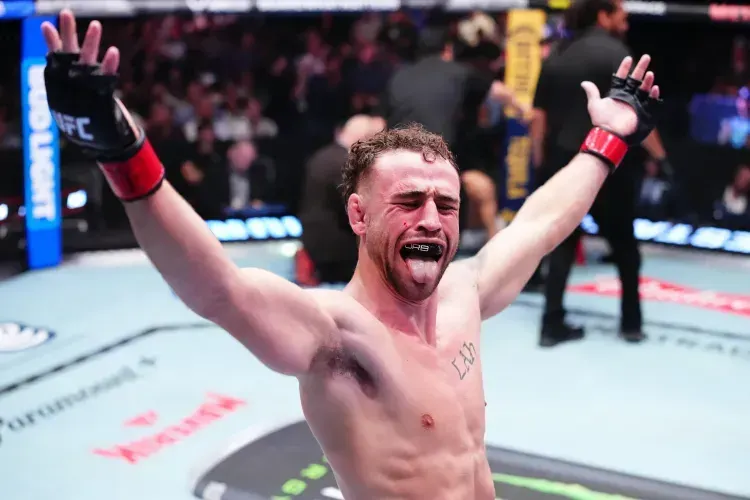
Brady Hiestand spent nearly two years away from the UFC recovering from a second ACL surgery.
When he returned Saturday night, he did not receive a comfortable assignment. He drew Rinya Nakamura, a former world-class wrestler whose path toward the Olympics had made him one of the most decorated grapplers in the bantamweight division.
Hiestand responded by winning the fight where Nakamura was expected to be strongest.
After forcing a series of transitions on the mat, Hiestand took Nakamura’s back and finished a rear-naked choke at 4:07 of the second round at UFC Vegas 121 on September 26.
For a fighter returning from another major knee injury, the result was more than a comeback win. It was evidence that Hiestand’s best weapon remained intact.
A Return Built Around Pressure
The matchup carried an obvious question before the opening bell.
Could Hiestand impose his high-output grappling against an opponent with Nakamura’s wrestling pedigree?
UFC’s own pre-fight coverage described Nakamura as a world-class wrestler who had pursued an Olympic path before transitioning to mixed martial arts. He entered the bout with an 11-1 professional record and three UFC victories. Hiestand, meanwhile, had not competed since August 2024.
That layoff followed a second ACL surgery. Hiestand told UFC that the recovery included setbacks, inflammation and the frustration of losing the momentum created by three consecutive UFC wins.
He also made his plan unusually clear. Hiestand said he expected his pace to break Nakamura and wanted to find a finish.
That prediction became the structure of the fight.
The Finish Began Before the Choke
The rear-naked choke will be the official ending, but the most instructive part of the sequence was what came before it.
Hiestand did not treat the first attack as the only attack. He threatened a D’Arce choke, used Nakamura’s reaction to continue moving through the position, secured the back and then closed the space required for the rear-naked choke.
That chain matters.
Against a strong wrestler, the first opening may not remain open. An opponent with Nakamura’s base and scrambling instincts can make a single attack disappear quickly. Hiestand’s answer was to make each defense lead toward the next problem.
The D’Arce threat became back exposure. Back exposure became control. Control became the choke.
It was not a victory built around catching Nakamura in one isolated mistake. It was a victory built around refusing to let the exchange reset.
What the Win Says About Hiestand
Hiestand is still only 26, but his UFC career has already required the patience of a much older fighter.
Inactivity can change how a fighter competes. A long rehabilitation can create hesitation in the very positions that once felt automatic, particularly when the injury involves the knee and the athlete’s style depends on wrestling pressure, mat returns and repeated changes of direction.
Hiestand did not look like someone protecting a repaired joint or trying to ease back into competition.
He looked like himself.
That may be the most important takeaway from UFC Vegas 121. The win extends his streak to four UFC victories, but the manner of the victory says more than the number. Hiestand returned against one of the division’s most credentialed wrestlers and trusted the grappling exchanges instead of avoiding them.
For jiu-jitsu practitioners, the finish is a useful reminder that submission sequences are rarely as simple as the final grip. Hiestand’s success came from linking attacks and positions until a talented opponent ran out of clean exits.
Two years away ended with one familiar pattern: pressure, transition, back control and a choke.