

While helping move my daughter into her new college apartment, I saw one of those little automated delivery robots coming down the sidewalk. Electronic eyes blinking. Minding its own business. Looking cute, honestly.
Then a young cyclist rode past it and blasted a drive-by side-kick to the side of it. Boom! And kept moving.
It caught me off guard. Why would he do that?
I did not see serious damage. I also do not know why he did it. Maybe he had an opinion about the technology. Maybe he was showing off. Whatever the reason, it was not his property. He had no idea who was waiting for that delivery or what it meant to them. It could have been helping somebody who had difficulty getting out. I do not know. Neither did he.
What stayed with me was how casually he took the shot and moved on.
I kept thinking about that while watching the situation involving Rener Gracie and Clarence Chamorro unfold. Different circumstances, obviously. But the same question kept coming back:
What does the way we express disagreement say about us?
As instructors. As parents. As leaders. As people. As a culture.
You can disagree without getting personal
Clarence, a brown belt teaching in Vermont, publicly challenged the ability of ALL Gracie University purple belts (contrary to this narrative that I've seen being spun about "he meant online students". Though he may have meant to have it implied. It wasn't. "ALL.") and invited them to come prove him wrong. He also directed a personal insult at Rener. Straight out of left field and unprovoked.
Now, questioning a curriculum is fair. Questioning standards is fair. We should be able to discuss how people train, how they earn rank and whether what they are learning holds up under resistance. Nobody gets a lifetime exemption from questions because of their last name.
But what does telling somebody off add to that conversation?
You are talking to another human being. A father. An instructor. Somebody who has devoted his life to the same art you teach. You do not have to like his delivery, his business or every position he takes to recognize that.
And if you are going to call out the Gracies, their history should probably be part of your homework.
This family has answered challenges before
Long before reels and comment sections, there was the "Gracie Challenge". The Gracies in Action tapes put some of those encounters in front of people who might otherwise never have understood what this art could do.
Jason DeLucia was one of the people who answered that challenge. He tested himself against Royce Gracie before the UFC, lost, and kept fighting. He became an alternate at UFC 1, returned at UFC 2 and eventually faced Royce again. DeLucia would go on to build a serious career during the early days of MMA.
That's the history we're talking about.
Understand. Rener wasn't somebody who was just told about these days and discovered that history later. He was simply raised in it.
And understanding that culture matters. If you position yourself as an educator, own an academy and teach these techniques to other people, knowing the history and culture behind what you're teaching should be a foundational core value.
You don't have to agree with everything the Gracies have done, or everything Rener teaches today. But you should understand the shoulders you're standing on before publicly dismissing the people who helped build the platform you're teaching from.
His father, Rorion Gracie, was staging challenge matches out of the family's Southern California academy before helping create the UFC in 1993. Rener and his brothers grew up around their father and uncles testing jiu-jitsu against people who showed up believing they had something better.
At UFC 1, Rener's older brother Ryron was still a kid and was literally one of the towel boys wiping blood from the canvas between fights. Rener was right behind him, growing up in that same environment.
This was their childhood.
And if you really want to understand that culture, look up what happened when Japanese professional wrestler Yoji Anjo flew from Japan to challenge Rener's uncle Rickson Gracie at his academy in 1994.
Anjo arrived from Japan accompanied by members of the Japanese press. Rickson wasn't at the academy when he arrived. He was called, came down and accepted the challenge. The media weren't allowed inside for what happened next.
There was a camera in the room, but the footage has never been publicly released. The photographs of Anjo afterward told enough of the story. Rickson himself has also recounted the encounter. On The Mat
If you don't know that story, look into it. It's a good one.
And while you're doing your homework, look up a young Rener Gracie competing against Jason "Mayhem" Miller.
Yes, that Mayhem Miller. The future MMA fighter and personality who would eventually host Bully Beatdown. And there were some other names around that event that longtime jiu-jitsu and MMA fans should recognize too.
Again, look it up.
There is even old Gracie Challenge footage that never made it into the original releases. Watching some of it now is a reminder of just how different the culture surrounding these challenges was before social media existed.
That's part of why the reaction to this particular challenge struck me as strange.
You can criticize Gracie University. You can question the curriculum. You can question rank standards. All of that is fair.
But if you're going to publicly challenge the ability of ALL of their purple belts and personally disrespect Rener Gracie while doing it, you should probably understand who you're talking to and the environment that produced him.
The Gracies have been answering challenges for a very long time.
So if you issue that particular invitation, you might want to know the family history first.
They have a habit ofRSVP'ing.
The internet met the mat
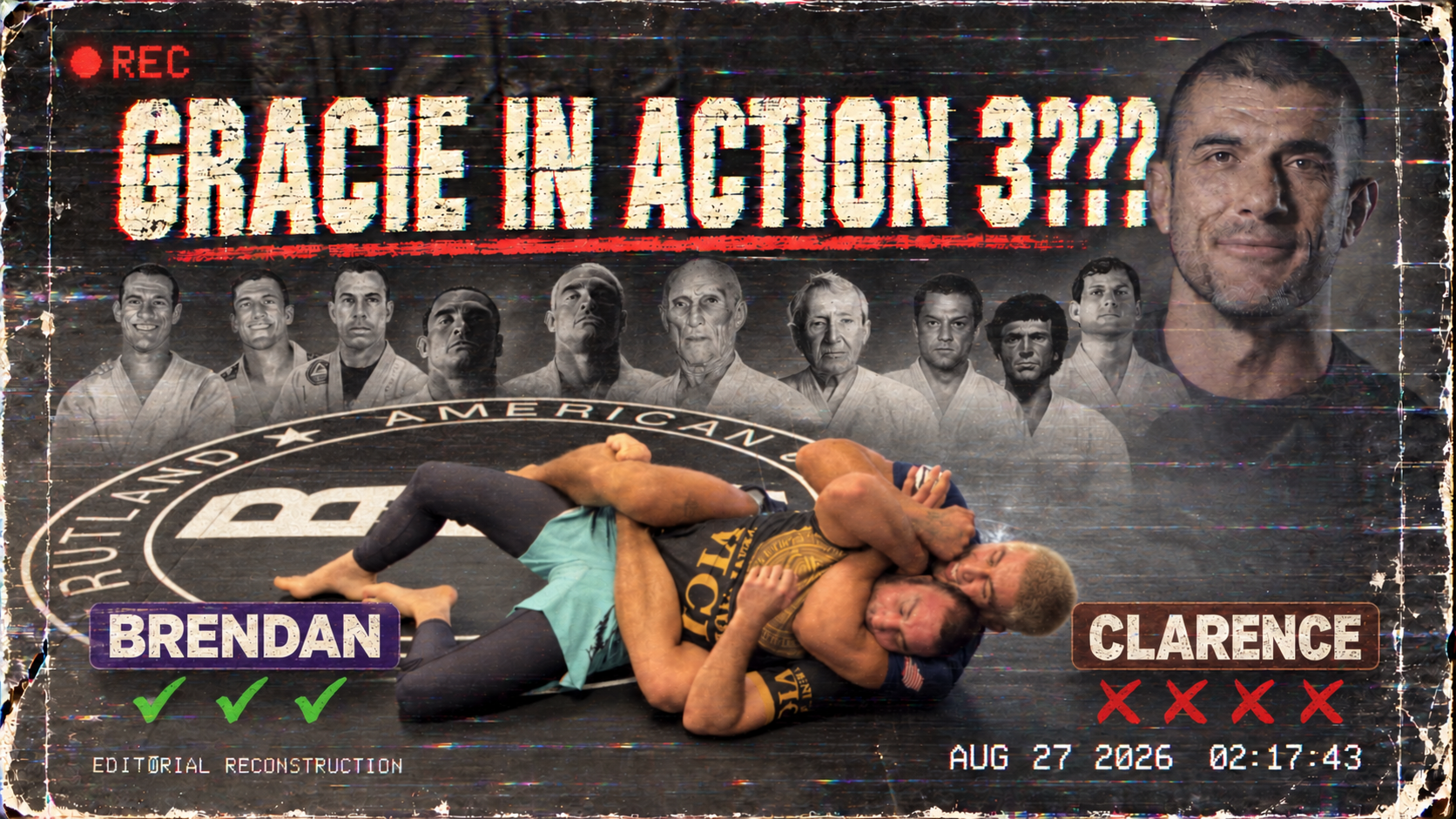
Brendan Farnsworth made the trip from California with Bernardo Figueiredo. Clarence welcomed them and rolled. In GracieBreakdown's Gracie Challenge 2.0 documentary, Farnsworth repeatedly submits him.
The part I appreciated was the restraint.
They trained. Clarence accepted the exchange, allowed filming and gave Brendan credit afterward. That deserves to be acknowledged.
This was an agreed grappling session. Nobody needs to turn it into an endorsement of showing up uninvited and threatening somebody over an internet argument.
And one brown belt tapping to one purple belt does not settle every question about a curriculum or tell us everything about either person's teaching ability. What it does challenge is the confidence of a sweeping dismissal.
"I didn't think that my shit talking online would get people to show up..."
Clarence's own response describes his surprise that the online talk actually brought people to his academy. That is the part that reaches beyond jiu-jitsu for me.
He was not anonymous. His name and his school were attached. But distance can give us some of the same comfort. We say something reckless, close the app and assume the person on the other end stays on the other end.
That person is real whether they ever show up or not.
Respect should not depend on the likelihood of a face-to-face conversation.
The apology with a cushion underneath it
Then I read Clarence's response on Instagram.
He acknowledged the provocative posts, credited Brendan and described the visit. He also brought up age, weight and interrupted sleep while caring for a young baby as circumstances he could have used as excuses.
That is where he lost me.
When I describe it as a “fake apology,” I mean how it reads to me. I cannot tell you what was in his heart. He may sincerely have felt that he was taking responsibility. The post does give Brendan credit.
But the accountability arrived with a cushion underneath it.
You cannot put all the reasons on the table and then expect them to disappear because you introduced them as excuses you were not going to make.
"I could have made many excuses about age or weight or that I have a 2 month old and haven't slept well in months, but instead we slapped bumped and went for it."
I understand being tired. I understand parenting. I understand that age and size affect performance. Those are real variables, and pretending they never matter would be dishonest.
But none of them explains why another instructor deserved the personal disrespect in the first place. An explanation for a difficult round does not answer for the decision to make that public statement.
Those are two different things to own.
The escape clause can become a chain
We see this mentality far beyond Clarence.
I have heard it around competitions for years. The other guy was bigger. I was the oldest in the division. The referee had it out for me. I would have won under different conditions.
Sometimes there is a legitimate issue to examine. But if the explanation always leaves our self-image untouched, what exactly are we learning?
You can give yourself an out so often that it becomes the thing chaining your potential.
Every uncomfortable result gets explained away before it has a chance to teach you anything. Your ego gets to leave the room feeling fine. Your weak position, poor decision or bad habit comes home with you.
Then the same thing happens again.
That is how you can keep training without truly evolving. You are putting in the hours while defending the very thing that needs to change.
The useful question is specific.
Why did he get behind me?
Where did I lose the hand fight?
What did I assume about him?
Why did I think insulting someone was an acceptable way to make my point?
Now we have something to work with.
Accountability does not require you to pretend that circumstances do not exist. It requires you to stop using those circumstances to avoid the part that belongs to you.
As instructors, that matters twice. Our students hear what we teach, but they also watch what we do when our pride gets touched. If every loss comes with a disclaimer, we are teaching that habit too.
We tell students the tap is information.
We have to be willing to receive it ourselves.
Give the next step a chance
The follow-up is why I do not see this as a story that has to end in humiliation.
In GracieBreakdown's Thank You Rener follow-up, the conversation moves toward an apology and Rener's invitation for Clarence to come train at Gracie University.
That is an opportunity.
Go learn from the people you dismissed. Ask questions. See the environment for yourself. Let the experience change more than the wording of the next caption.
What matters is whether the next action reflects a different understanding.
We cannot demand accountability and then refuse to let anybody move forward after accepting it. If we really want people to grow, we have to leave room for growth.
My $0.02
I keep coming back to that little robot that took one to the side.
The cyclist took his shot and moved on. I was left wondering how easily we act without considering what our behavior says about us or who else it touches.
We tell our children to respect people. We tell our students to control their reactions. We tell ourselves that jiu-jitsu makes us better.
Then somebody disagrees with us.
Then we lose.
Then our pride gets involved.
That is where those lessons have to show up.
Clarence has an opportunity here. So do the rest of us.
Own the words. Own the result. Give credit without immediately negotiating it back. Take the lesson somewhere useful.
Because if you always leave yourself an exit from accountability, you may also be closing the door on the person you could become.
What is YOUR voice in this culture saying?
The tap can end the round. But what we do afterward determines whether we learned anything.