

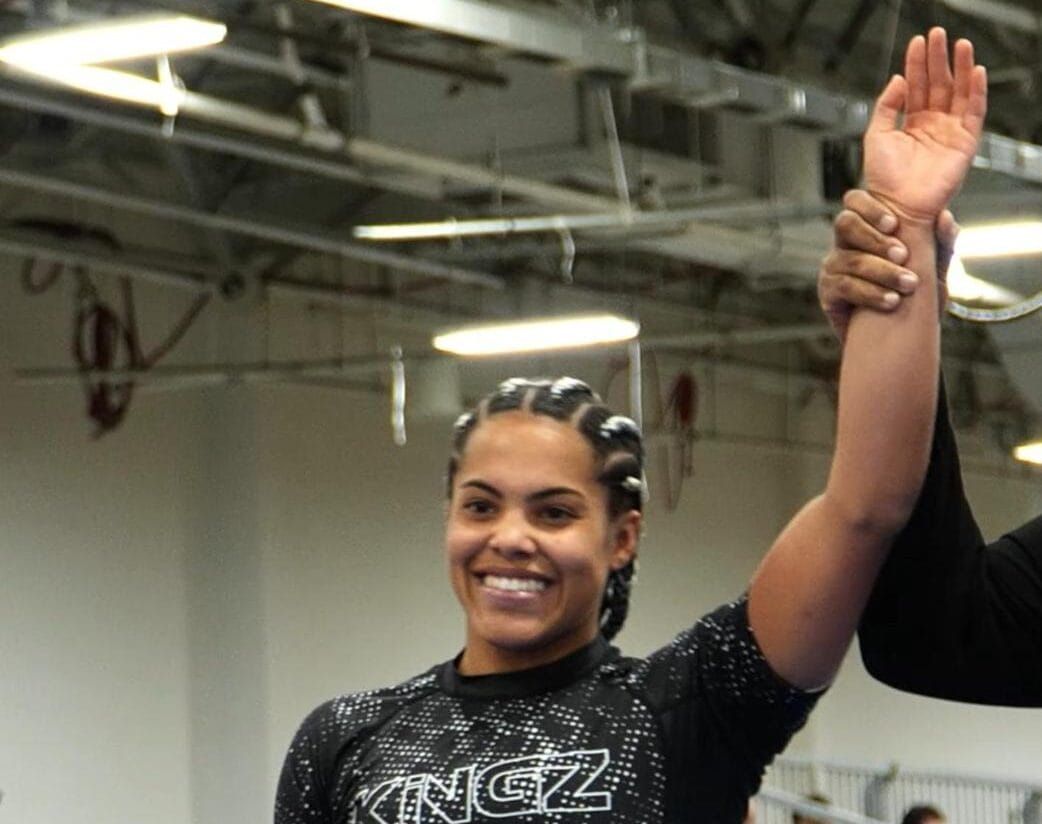
Sarah Galvao entered two Pan Championships in 2026 and left with every gold medal available to her.
On Sunday, October 4, the Atos black belt won the middleweight and absolute divisions at the IBJJF Pan No-Gi Championship in Secaucus, New Jersey. The double-gold performance came six months after she won lightweight and absolute gold at the Pan Jiu-Jitsu Championship in the gi.
Four divisions. Four gold medals.
More importantly, the results show that one of the sport’s fastest-rising athletes is no longer simply collecting titles inside a preferred ruleset or weight class.
Six Matches Across Two Days
Galvao’s Pan No-Gi run required six victories across the weekend.
She opened the absolute bracket with submissions over Sa’idah Durkee and Julia Maele, then defeated Nadia Frankland in the semifinal. She also beat Maele in the middleweight bracket to reach a second final.
Sunday brought two more matches and two more championships.
Galvao defeated Frankland again to claim the middleweight title, then beat Maria Vitória Ruffatto-Gilpin in the absolute final. Ruffatto-Gilpin entered the match with a significant size advantage and had already earned a bronze medal in the absolute division at the 2026 World Championship.
The open class is where Galvao’s year becomes especially difficult to dismiss. It asks athletes to solve problems that do not exist inside a single weight category, and it has now become the defining stage of her 2026 season.
The Pan Sweep Started in March
Galvao’s first two Pan gold medals came in the gi.
She won the lightweight division after a close final against Janaina Lebre, then entered the absolute bracket and produced one of the year’s biggest results against Gabrieli Pessanha.
Pessanha carried the size advantage and led deep into the match. Galvao changed the result in the final seconds, completing a single-leg attack, reaching the back and scoring the points that gave her the championship.
That win mattered beyond the medal. It showed that Galvao could remain dangerous even when the match, the clock and the physical matchup were all working against her.
Pan No-Gi presented a different set of problems, but the result was the same.
Winning Without Depending on One Version of Jiu-Jitsu
The gi and no-gi versions of elite competition increasingly reward different habits.
Grip fighting, lapel control and the slower accumulation of positional pressure can shape a gi match. No-gi competition generally creates faster transitions, more wrestling exchanges and greater exposure to leg attacks.
Winning in both does not mean an athlete uses the same game everywhere. It means the athlete can preserve an identity while changing the tools.
That may be the most useful way to understand Galvao’s four Pan titles.
Her success is not tied to one uniform, one opponent type or one division. She has now won the open class in both formats during the same calendar year, while also taking gold in two different weight categories.
That kind of range is becoming more valuable as the sport continues to separate into specialized competitive worlds.
A Family Weekend, but Sarah’s Result Stood Alone
There was another Galvao on the podium in New Jersey.
Andre Galvao returned to tournament competition for the first time since ADCC 2022 and earned silver in the super-heavy division. The title went to his Atos student Nata Tenca.
The family connection added context to the weekend, but Sarah’s performance did not need it to feel significant.
She arrived as an established black belt contender, won six matches and left as the most successful woman at the tournament.
The story is no longer that she is following a famous path.
She is building one that can be measured on its own.
Four Gold Medals, One Clear Direction
Galvao’s 2026 Pan season began with a dramatic victory over one of the most dominant champions in jiu-jitsu. It ended with another absolute title in a different format.
Between those moments, she showed that the result in March was not a single breakthrough that needed to be explained away.
It was the beginning of a pattern.
Sarah Galvao entered the year as one of the most promising young black belts in the sport. After sweeping the gi and no-gi Pan Championships, promise is no longer the most accurate word.
Four gold medals have a way of changing the conversation.