

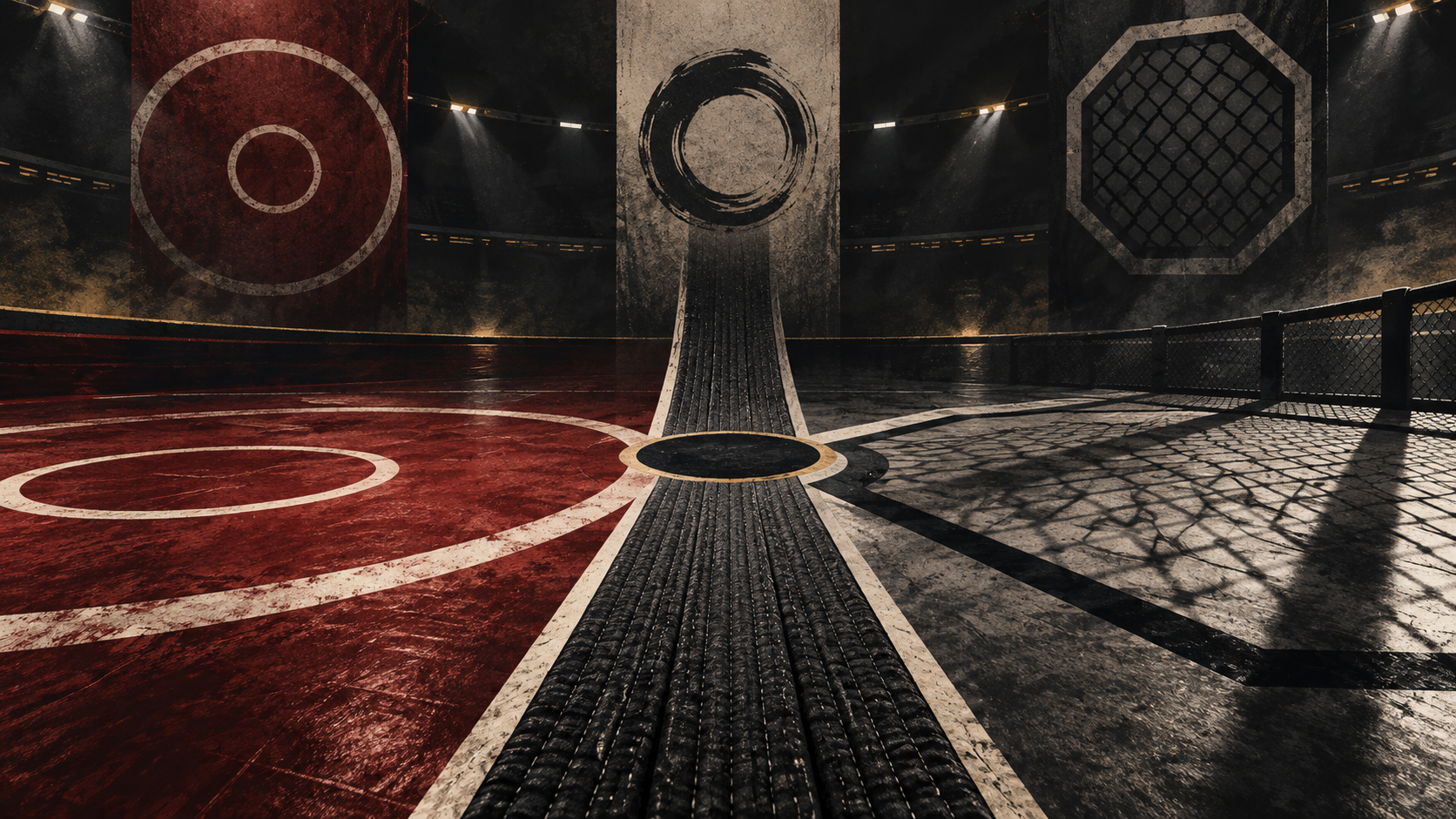
Khamzat Chimaev did not need an MMA cage to make his grappling look overwhelming.
On September 18 at RAF 13 in Miami, Chimaev defeated Gilbert Burns by 15-4 technical fall. Burns scored twice, forced the match into a second period and gave Chimaev more resistance than any of his previous Real American Freestyle opponents.
The ending was still decisive.
Chimaev’s final four-point takedown closed the match and completed a two-week experiment that JJM had been tracking since the pairings were announced.
First came Tyron Woodley, a former UFC champion and two-time NCAA Division I All-American wrestler. Then came Burns, a jiu-jitsu world champion whose competitive identity was built around submissions.
Two accomplished grapplers. Two different foundations. One narrow wrestling ruleset.
That distinction matters.
THE WRESTLER
Chimaev’s September 5 match with Woodley barely lasted long enough to develop.
Woodley attacked a single leg, but Chimaev countered, collected two push-out points and quickly turned the next exchange into a lift and slam. The pin arrived after only 94 seconds.
The result was striking because Woodley’s wrestling résumé was not a decorative line in an MMA biography. He was a two-time All-American at Missouri before beginning his fighting career.
But the names and credentials alone can be misleading.
Woodley was 44, smaller than Chimaev and competing against an athlete still close to his physical prime. His collegiate history explained why the matchup was interesting. It did not freeze either man at the age or competitive condition in which those credentials were earned.
Chimaev nevertheless did something important. He removed the striking, the cage and the threat of submissions, then dominated an accomplished wrestler inside a wrestling match.
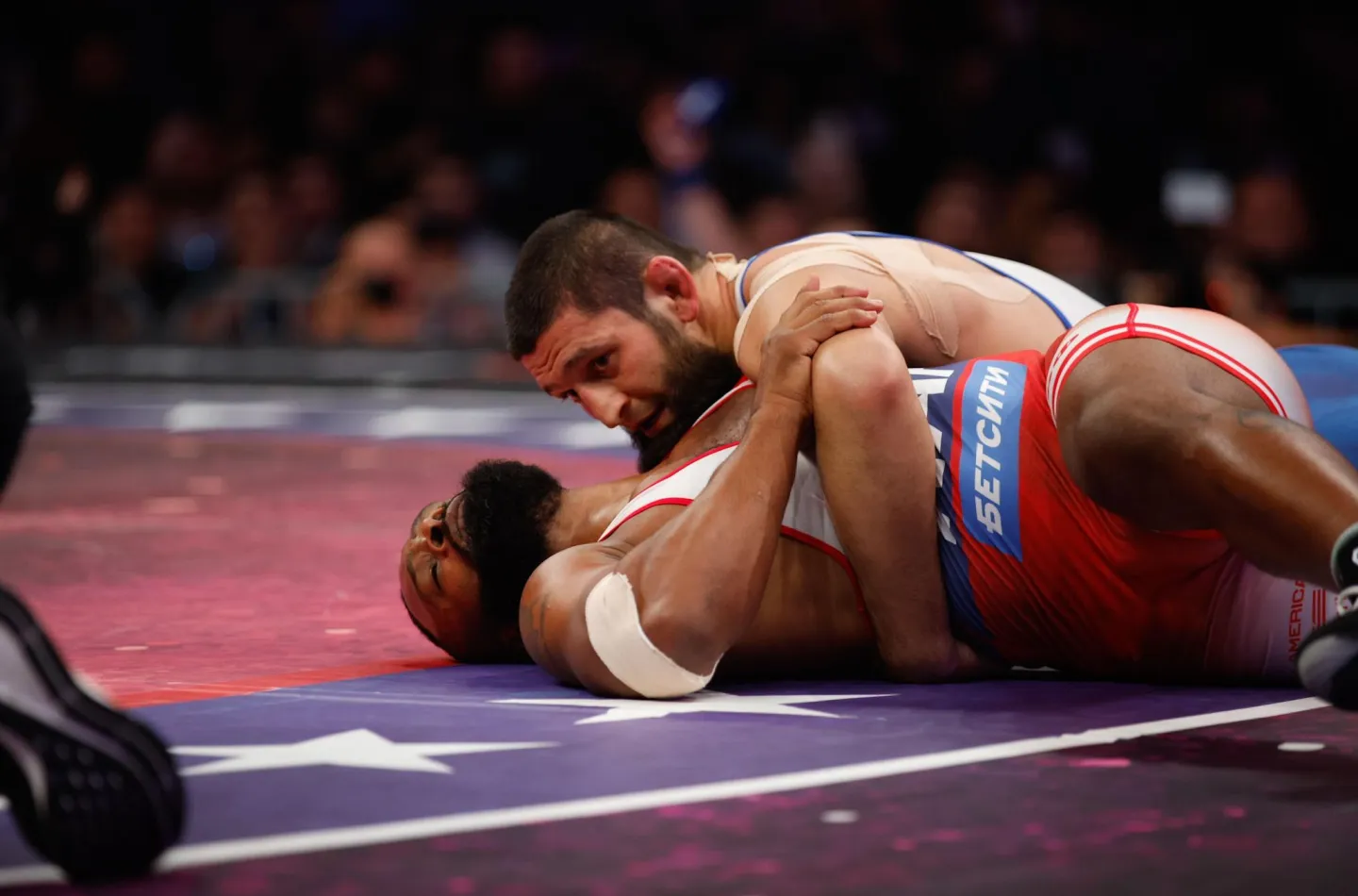
That made the Burns test more compelling.
THE JIU-JITSU CHAMPION
Burns presented a different problem.
His best competitive achievements came through jiu-jitsu, not collegiate or international freestyle wrestling. In MMA, however, Burns developed an explosive takedown game that helped connect his jiu-jitsu to the rest of the fight.
Against Chimaev, those takedowns were not theoretical.
After Chimaev built an early 5-0 lead, Burns drove forward for a two-point takedown. He added another in the second period, becoming the first RAF opponent to extend Chimaev beyond the opening period.
That deserves recognition. Burns did not simply survive. He created offense inside Chimaev’s preferred phase of the match.
Chimaev answered every success with more volume and greater scoring value. He led 11-2 after the first period and ended the contest when another double-leg produced the four-point move needed for technical superiority.
Burns showed that Chimaev could be taken down.
He did not show that Chimaev could be slowed down.
WHAT THE TWO MATCHES ACTUALLY TELL US
It would be easy to turn the results into a simplistic argument about wrestling defeating jiu-jitsu.
That would miss the point.
Burns was not allowed to attack the neck, isolate an arm or use the guard as an offensive destination. Woodley was not competing under the collegiate rules that shaped much of his development. Both men entered Chimaev’s current professional wrestling environment, where exposure, push-outs, takedown value and technical-fall margins determine the result.
These were wrestling matches, not universal measurements of grappling.
What they did measure was whether Chimaev’s control could survive after the familiar machinery of MMA was removed.
It did.
In MMA, Chimaev can use punches to force reactions, the fence to contain movement and submission threats to punish an opponent who turns away. RAF took those tools away. His pressure, balance, timing and ability to finish takedowns remained.
That is the meaningful conclusion.
Chimaev’s grappling dominance does not belong entirely to MMA. Some of it is produced by the full ruleset, as it is for every fighter. But the foundation travels.
Woodley tested the wrestling pedigree. Burns tested the jiu-jitsu crossover. Neither result looked competitive for very long, even though Burns managed to expose a few more openings.
THE NEXT TEST IS CLEARER
After beating Burns, Chimaev called for RAF crossover champion Colby Covington.
Covington had just shut out Belal Muhammad 10-0 in the RAF 13 main event. Unlike the Woodley and Burns pairings, a Chimaev-Covington match would place him opposite an active RAF champion who is already succeeding consistently under the same scoring system.
That would be a cleaner competitive comparison.
It would also be the logical third chapter.
Woodley showed that an elite wrestling background does not guarantee an answer. Burns showed that high-level jiu-jitsu and MMA takedowns can create moments of offense without stopping the larger wave.
Covington would test whether Chimaev can impose the same pressure against the man currently holding the crossover belt.
For now, the two-match experiment has provided its first answer.
Take away the strikes. Take away the submissions. Take away the cage.
Khamzat Chimaev is still exceptionally difficult to move, contain or stop.