

UFC Edmonton will be remembered first for Mike Malott’s main-event knockout, but the card also produced one of the weekend’s most varied displays of submission finishing.
Five of the 13 fights on October 17 ended by submission. The methods covered two kimuras, two rear-naked chokes and a face crank. That variety mattered more than the raw total. The finishes came from different positions, at different stages of the fight and under very different kinds of pressure.
For jiu-jitsu viewers, the card offered a compact reminder that the same goal can emerge from several routes.
Two Kimuras, Two Different Timelines
SuYoung You and Chelsea Chandler finished with the same submission, but they arrived there in opposite ways.
You spent much of his bantamweight fight with Cody Chovancek using takedowns and top control to dictate the exchanges. The finish did not arrive until 4:19 of the third round. Chovancek tried to create offense late, exposed his arm in the process and gave You the opening to secure the kimura.
Chandler needed far less time. She submitted Melissa Croden with a kimura at 4:52 of the opening round, closing the fight just before the horn.
One finish was the final answer after nearly 15 minutes of control. The other was a first-round conversion. Together, they showed why the kimura remains more than a single submission. It can be a finish, a control position and a reaction to an opponent trying to escape.
Watch UFC’s official SuYoung You submission highlight
Late Pressure and an Immediate Debut
Steven Koslow returned after nearly four years away and submitted Chad Anheliger with 29 seconds remaining in the third round. The rear-naked choke came after a fight in which Koslow repeatedly worked to bring the action to the mat.
That timing made the finish especially revealing. A late third-round submission is rarely just about recognizing the final opening. It is also about continuing to build pressure when fatigue makes every transition less precise.
Nick Galanti worked on the opposite clock. In his UFC debut, he took Julien Leblanc down and secured a face crank in 86 seconds. Galanti entered the Octagon with a reputation as a finisher and immediately carried it onto the larger stage.
The contrast was clean. Koslow needed almost the entire fight to complete his work. Galanti needed less than a round to establish where the match belonged.
Cuamba Finds a New Kind of Win
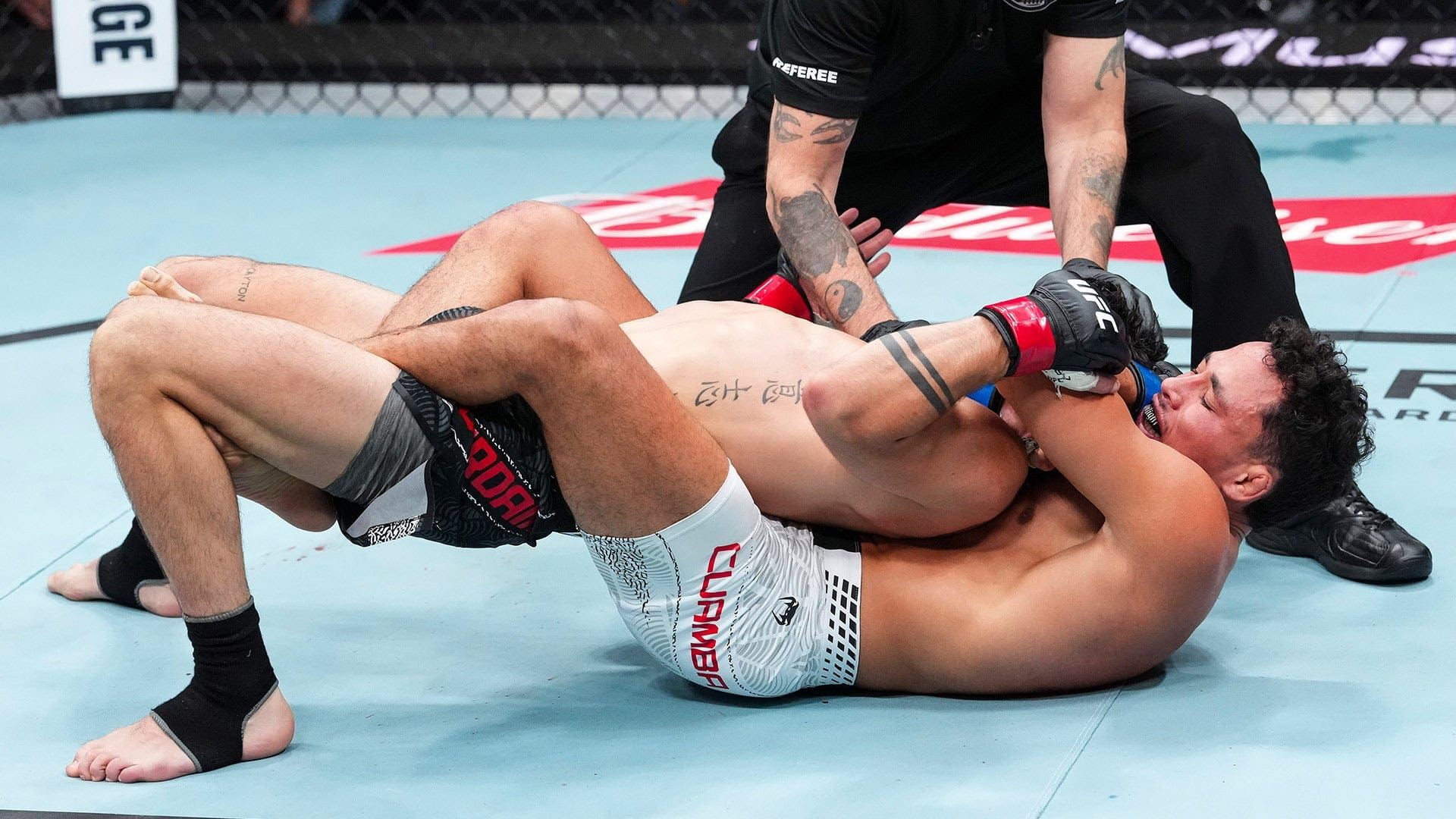
Timmy Cuamba supplied the fifth submission and perhaps the most unexpected one.
Cuamba had built his professional record with five knockouts and five decisions, without a submission victory. Against Louis Jourdain, he controlled the opening round, took the back in the second and finished with a rear-naked choke at 2:48.
It was Cuamba’s first professional submission and a useful expansion of how opponents must now prepare for him. A fighter known primarily for striking does not need to become a pure grappling specialist to change the scouting report. He only needs to prove that a back take can end the fight.
Watch UFC’s official Timmy Cuamba submission highlight
More Than a Submission Count
Submission totals can flatten very different performances into one statistic. UFC Edmonton was more interesting when viewed as five separate problems.
You and Chandler attacked arms. Koslow stayed patient until the back opened. Galanti forced an immediate tap in his debut. Cuamba added an entirely new finish to his professional résumé.
Five submissions and five distinct paths to the same result.
That is the part of the card worth keeping.